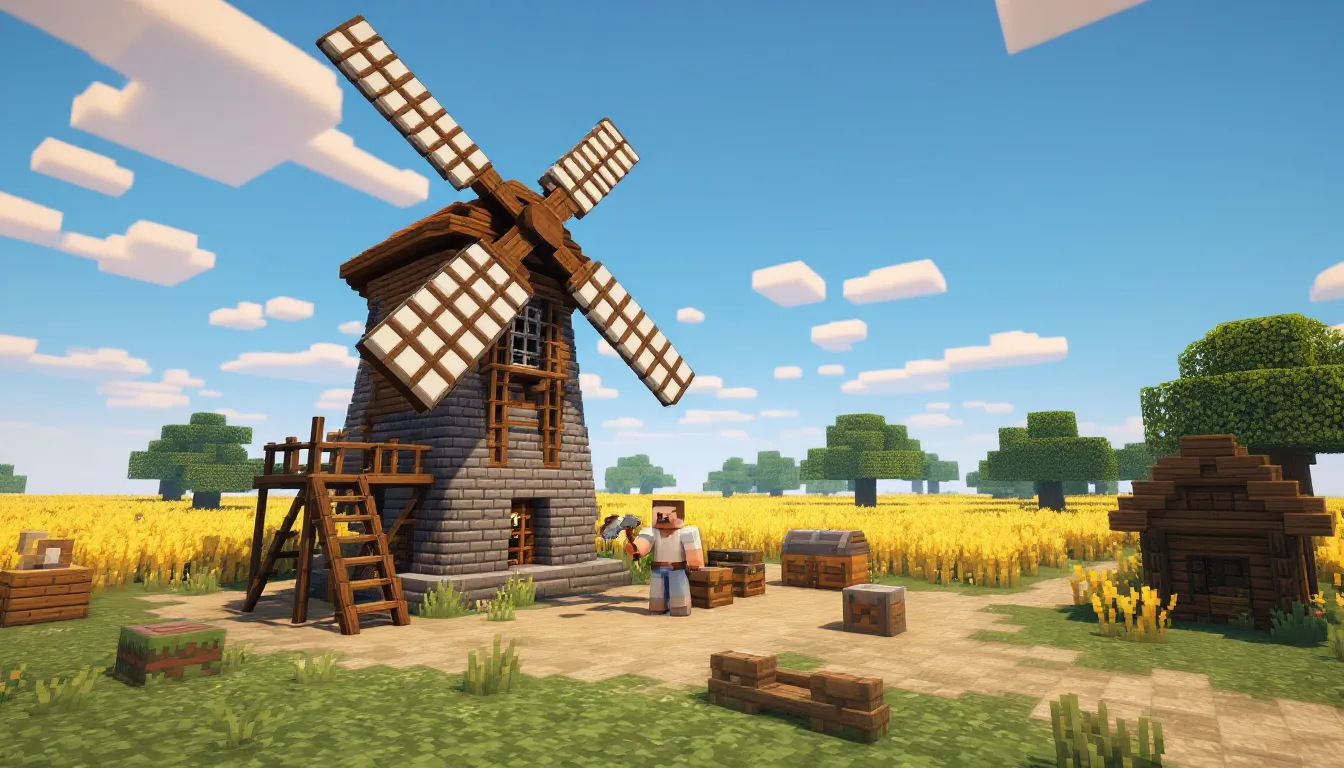
Windmills are one of those builds that instantly elevate any Minecraft world from “bunch of boxes” to “actual settlement.” Whether you’re setting up a wheat farm, creating a medieval village, or just want something tall and impressive on the horizon, a well-designed windmill delivers aesthetics and purpose. But here’s the thing: a bad windmill looks worse than no windmill at all. Stubby blades, wonky proportions, or a base that doesn’t match the build style can ruin the effect.
This guide walks through everything from picking the right blocks and location to constructing functional redstone-powered blades. Whether you’re grinding in survival or flexing in creative, you’ll learn how to build windmills that actually look good and fit your world’s vibe. Let’s get building.
Key Takeaways
- A well-designed windmill Minecraft build transforms your world from functional to memorable by providing vertical interest, justifying farming infrastructure, and working across multiple biomes and build styles.
- Successful windmill construction requires the right block palette—mix Oak Planks, Cobblestone, and Stripped Logs for texture—and proper proportions, with blades extending at least as far as the tower is tall to avoid looking stubby or unbalanced.
- Windmill towers should taper inward as they rise (stepping inward every 3-4 blocks) rather than staying straight-sided, which makes them look like silos instead of authentic mills.
- Interior design matters: add storage, workspaces, and lighting throughout multiple floors to make your windmill feel lived-in and complete, from ground-floor workshops to beacon-style roof lighting.
- Choose windmill locations with breathing room—plains biomes, village edges, or hilltops work best—and avoid dense forests or cramped spaces where the build loses visual impact.
- For animated windmills, use the Create mod for true rotating mechanics and functional grain-grinding capability, or leverage vanilla redstone with Observers and Pistons to add interactive elements like auto-harvest farms and light activation.
Why Build a Windmill in Minecraft?
Windmills aren’t just decorative, they solve practical and aesthetic problems in your world. First, they provide vertical interest. Flat bases and single-story farms get boring fast, and a windmill breaks up the skyline without requiring the material investment of a full castle or tower.
Second, windmills justify farming infrastructure. Got wheat fields, pumpkin patches, or sugarcane farms? A windmill ties them together thematically and makes your base feel lived-in. It’s the difference between “I placed crops” and “I built a functioning farmstead.”
Third, they’re flexible. Windmills work in plains biomes, flower forests, villages, or even snowy tundra. They scale well, build a small one for a starter base or go massive for a centerpiece build. And if you add redstone, you get actual moving parts, which immediately impresses anyone touring your world.
Finally, windmills are iconic. They’re instantly recognizable, culturally rich (Dutch, medieval, rustic), and players of all skill levels can tackle them. You don’t need command blocks or structure voids, just solid building fundamentals.
Essential Materials and Tools for Your Windmill Build
Best Blocks for Windmill Construction
Your block palette makes or breaks the build. For a traditional rustic windmill, Oak Planks and Cobblestone form the core. Oak gives warmth: cobblestone adds weight and texture to the base. Spruce works too if you want a darker, moodier look.
For accents, mix in Stone Bricks, Stripped Oak Logs, and Oak Fences. Fences are perfect for support beams and scaffolding details. If you’re going medieval, throw in some Andesite or Dark Oak Trapdoors for weathered texture.
Blade material matters. Oak Fences are the classic choice, they’re thin, repeatable, and look like actual wooden frames. For sails, use White Wool or White Concrete depending on whether you want a softer or cleaner finish. Some builders use Birch Planks for the blade frames to contrast the darker tower wood.
Avoid blocks that are too bright (like Quartz) or too modern (like Smooth Stone) unless you’re intentionally building a futuristic turbine. Windmills should feel grounded and historical.
Tools You’ll Need
In survival, bring:
- Axe (for harvesting wood and stripping logs)
- Pickaxe (for stone and cobblestone)
- Shears (if you’re using wool for sails)
- Scaffolding or Dirt Blocks (for building height safely)
- Water Bucket (in case you fall, always)
In creative, hotbar your block palette and keep Barrier Blocks handy if you’re testing redstone or want invisible supports. A few Slabs and Stairs help add depth to walls and rooflines without bulk.
Choosing the Perfect Location for Your Windmill
Windmills need space and context. Cramming one next to your starter dirt hut won’t work, they need breathing room and a reason to exist.
Plains and sunflower plains are classic. Flat terrain, wide skies, and room for wheat fields make windmills feel natural. If you’ve already got a farm going, build the windmill at the edge or center as a focal point.
Villages are perfect if you’re expanding or renovating. Replace a house or build just outside the village boundary. Windmills enhance the “lived-in” vibe and give villagers a purpose (even if they don’t actually use it).
Hilltops work for dramatic builds. A windmill perched on a hill overlooks your base and doubles as a landmark for navigation. Just make sure the terrain isn’t so steep that the build feels unbalanced.
Avoid dense forests or cramped spaces. Windmills lose impact when trees or buildings crowd them. You want at least 10-15 blocks of clearance on all sides, more if you’re building large blades.
Consider orientation. Face the blades toward your main approach path or base entrance so they’re visible when you return home. It’s a small detail that makes the build feel intentional.
Step-by-Step Windmill Base Construction
Building the Foundation
Start with a circular or octagonal base, 7×7 or 9×9 works for medium builds. Mark out your perimeter with cobblestone or stone bricks. If you’re not confident with circles, use an online circle generator or freehand an octagon (it’s easier and looks almost as good).
Dig down one block and fill with Stone Bricks or Cobblestone to create a slightly raised platform. This prevents the windmill from looking like it’s sinking into the ground.
Add a ring of Oak Fences or Stone Brick Walls around the perimeter for detail. These little accents break up flat surfaces and add medieval charm. If you want an entrance, leave a 2-block gap on one side and frame it with Oak Doors or Spruce Doors.
Inside the base, consider adding a small storage area or workspace. Place a few Chests, a Crafting Table, and maybe a Furnace. Even if you don’t use them, they add functionality and make the windmill feel lived-in.
Creating the Windmill Tower
The tower should taper slightly as it rises, walls that go straight up look like silos, not windmills. Start with your base diameter (7×7 or 9×9) and build up 8-12 blocks with Oak Planks and Cobblestone mixed in a checkerboard or banded pattern.
Every 3-4 blocks, step the walls inward by one block. So a 9×9 base becomes 7×7 halfway up, then 5×5 near the top. This taper is what makes windmills look natural.
Add Stripped Oak Logs vertically at the corners to frame the structure. These corner posts give the tower strength visually and break up monotonous plank textures.
At the top, build a small platform (5×5 or 3×3) that extends slightly beyond the tower walls. This is where the windmill blades will attach. Use Oak Slabs or Fences to create a railing or support beams around the platform.
For the roof, build a shallow cone with Oak Stairs or Spruce Stairs. Top it off with a single Oak Fence and a Torch or Lantern for a traditional cap. The roof shouldn’t dominate the build, keep it low and functional.
How to Build Windmill Blades That Actually Look Good
Static Blade Designs
Static blades are simpler and look great if proportioned correctly. The key is length and angle. Blades should extend at least as far as the tower is tall, if your tower is 12 blocks high, blades should be 10-14 blocks long from the center hub.
Start by building a central hub at the front of your platform. Use a 3×3 square of Oak Planks or Stone Bricks as the axle. From the center, extend four arms outward in a + or X shape using Oak Fences.
Each arm should follow this pattern:
- First 3 blocks: Fences straight out
- Next 4 blocks: Angle slightly downward (drop 1 block)
- Last 3 blocks: Continue the angle or flatten slightly
This creates a subtle curve that mimics real windmill blade physics without looking floppy. For sails, drape White Wool or White Concrete between the fence frames in a triangular or trapezoidal shape. Don’t fill the entire blade, leave gaps near the hub to show the frame structure, just like medieval builds often feature exposed beams.
Alternate sail styles: some builders use Banners hung on the fences, or Trapdoors layered for a slatted look. Experiment in creative first.
Animated Windmill Blades Using Redstone
Moving blades require redstone, patience, and a mod or command block setup, vanilla Minecraft doesn’t support rotating entities.
The simplest method uses Observers, Pistons, and Slime Blocks to create a push-pull effect. Build a vertical array of slime blocks behind the blade hub. Connect observers and sticky pistons in a clock circuit to pulse the slime blocks, making the blades “bounce” slightly. It’s not true rotation, but it adds life.
For actual rotation, you’ll need mods like Create (available on Nexus Mods), which adds rotational mechanics and windmill parts. The Create mod’s Windmill Bearings and Sail Frames let you build functional, rotating windmills that generate rotational force for other machines. It’s the gold standard for animated builds.
If you’re comfortable with datapacks or command blocks, armor stands with invisible hitboxes can fake rotation using /tp and /data commands. This is advanced and FPS-heavy, so only attempt if you’re experienced with commands.
Interior Design Ideas for Your Windmill
A hollow windmill is wasted space. Even if you don’t plan to use it much, adding interior details makes the build feel complete.
Ground floor: Storage and workspace. Line the walls with Chests and Barrels. Add a Crafting Table, Anvil, and Grindstone. Place Oak Trapdoors on the walls as shelves and stack Wheat, Bread, or Hay Bales on them. Throw down a Campfire (use trapdoors or carpets to prevent damage) for ambiance.
Mid-level: If your windmill has multiple floors (build ladders or stairs between them), use the middle as a living space. A Bed, Bookshelf, and Crafting Table turn it into a cozy refuge. Hang Lanterns from the ceiling and add a Rug (carpet on slabs) for warmth.
Top platform: Keep this sparse, it’s the machinery area. Place a Lectern with a map or Item Frames with tools to suggest maintenance work. If your blades are functional (modded), this is where the gear mechanisms sit.
Lighting is crucial. Use Lanterns, Torches, or Soul Lanterns (for darker aesthetics). Place them asymmetrically, not every corner needs light. Small windows (single-block openings with Glass Panes or Iron Bars) let in natural light and break up solid walls.
One clever trick: add a Hopper system feeding from a top-floor chest down to ground-level storage. It doesn’t do much in survival, but it implies functionality and gives you a reason to visit upper floors.
Advanced Windmill Design Variations
Dutch-Style Windmills
Dutch windmills are squat, wide, and feature steep roofs and cap rotation. Start with a broader base (11×11 or 13×13) and build only 8-10 blocks high before adding a large, conical roof. Use Brick Blocks or Red Sandstone mixed with Oak Planks for that classic Dutch palette.
The cap (the part that holds the blades) should be a separate, smaller structure on top of the main body. Build a 5×5 platform on top of your tower and construct a tall, pointed roof with Dark Oak Stairs or Brick Stairs. Attach your blades to the front of this cap, not the main tower. This two-tier design is iconic to Dutch mills.
Add Balconies or Platforms halfway up using Fences and Slabs. These provide scale and detail. Dutch mills often have external staircases or ladders, so consider building a spiral staircase outside using stairs and fences.
Medieval Fantasy Windmills
Fantasy windmills lean into asymmetry and weathering. Use Mossy Cobblestone, Cracked Stone Bricks, and Dark Oak for a decrepit, ancient look. Add Vines creeping up the sides and Moss Carpet on the roof.
Make the tower slightly crooked, offset walls by a block every few layers to create a leaning or sagging effect. It’s harder to build but looks amazing, similar to the charm found in creative shelter designs.
Blades can be tattered: use Cobwebs mixed with wool to suggest torn sails, or leave some blades incomplete with exposed fence frames. Add Glowstone or Soul Lanterns for eerie lighting.
Surround the base with Dead Bushes, Coarse Dirt, and Gravel to create a desolate, overgrown environment. Fantasy mills work great near abandoned villages or as dungeon entrances.
Modern Wind Turbines
For a sci-fi or industrial base, build a sleek wind turbine instead. Use White Concrete, Light Gray Concrete, and Iron Blocks. The tower should be thin and tall, 3×3 base, 20-30 blocks high.
Blades are minimalist: three long, narrow arms built with White Concrete or Quartz Blocks, each 15-20 blocks long and only 1-2 blocks wide. No sails, just smooth, aerodynamic shapes.
Top the turbine with a small housing unit (5×5) made of Iron Blocks and Glass Panes. Inside, place Redstone Lamps, Levers, and Iron Trapdoors to simulate machinery.
Add Lightning Rods to the top and surround the base with Concrete Powder or Gravel for an industrial site vibe. Wind farms work best in groups, build 3-5 turbines in a row for maximum impact.
Making Your Windmill Functional with Redstone Mechanisms
Vanilla redstone can’t create true blade rotation, but it can add interactivity and utility.
Auto-harvest farm integration: Run a redstone line from your windmill to nearby crop farms. Use Observers and Pistons to auto-harvest crops when they mature. The windmill “powers” the farm thematically, even if the mechanics are separate. This synergy is especially effective when you’ve already built functional farms nearby.
Light activation: Wire Redstone Lamps inside the windmill to a Daylight Sensor. The lamps turn on at night, simulating interior activity. Add lamps to the blade tips for a beacon effect visible from afar.
Door automation: Use Pressure Plates or Buttons to open the windmill door automatically. Small touch, but it makes entry feel modern and convenient.
Hopper systems: Install a vertical hopper chain from the top floor to the base. Drop items in the top chest (grain storage, thematically) and they funnel down to ground-level chests. Connect these to Minecart Hopper systems if your farm is nearby for full automation.
Sound effects: Place a Note Block inside the windmill connected to a slow clock circuit (use Repeaters set to max delay). The periodic tones mimic creaking wood or grinding gears. Pair this with Observers watching crop growth for event-driven sounds.
For serious functionality, install the Create mod. Its windmills generate rotational power (measured in stress units), which you can use to run Millstones (grind wheat into flour), Mechanical Presses, or Fans. This turns your windmill from decoration into a core part of your base’s automation network. Guides for Create mechanics are covered in depth on resources like Game8, which features detailed breakdowns of mod integration.
Common Windmill Building Mistakes to Avoid
Too-short blades. This is the #1 error. Stubby blades make your windmill look like a fan, not a mill. Each blade should extend at least as far as the tower is tall. Measure twice, build once.
No taper on the tower. Straight-sided towers look like silos or chimneys. Windmill towers should narrow as they rise. Even a 1-block reduction halfway up makes a massive visual difference.
Overusing one block type. All-oak or all-cobblestone windmills are flat and boring. Mix materials, planks for walls, logs for corners, stone for the base. Texture variation is what separates good builds from great ones, much like the attention to detail required in survival bunker builds.
Ignoring proportions. A 5-block tower with 20-block blades looks ridiculous. So does a 30-block tower with 6-block blades. Aim for tower height and blade length to be within 20% of each other.
Flat sails. Real windmill sails have depth. Use fences as frames and drape wool in triangular or trapezoidal shapes, leaving gaps to show structure. Solid walls of wool look heavy and wrong.
No surrounding context. A windmill floating in the void is pointless. Add wheat fields, paths, fences, maybe a small shed. Context sells the build.
Forgetting lighting. Dark interiors are wasted space and mob spawners. Place torches or lanterns inside and on the exterior for nighttime visibility. Unlit builds disappear after sunset.
Bad location. Building too close to other structures, in dense forest, or on uneven terrain ruins the effect. Windmills need space and flat or gently rolling terrain.
Windmill Building Tips for Survival vs. Creative Mode
Survival considerations:
- Prioritize local materials. If you’re in a plains biome with oak and cobblestone, lean into that. Don’t waste time hauling exotic blocks unless the windmill is a lategame showcase.
- Build scaffolding safely. Use actual Scaffolding blocks (crafted from bamboo) or pillar-jump with dirt. Falling from 20 blocks wastes time and resources.
- Light as you go. Place torches inside and outside during construction to prevent mob spawns. Nothing worse than a Creeper blowing a hole in your half-finished tower.
- Start small. A 7×7 base and 10-block tower is manageable early-game. You can always expand or build a second, larger mill later.
- Functional first. In survival, integrate the windmill with your farm. Build it near crop fields and use it as storage for wheat, seeds, and bread. Form follows function.
Creative advantages:
- Experiment with scale. Go massive, 15×15 base, 30-block tower, 25-block blades. Creative is where you test proportions and push limits.
- Try multiple styles. Build a Dutch mill, a fantasy ruin, and a modern turbine side-by-side. Compare and learn what works.
- Detail everything. Add interior furniture, redstone lighting, custom banner designs, and landscaping. Time isn’t a constraint, so layer details until it’s perfect.
- Use WorldEdit or structure blocks. Copy-paste blade designs to ensure symmetry. Rotate the windmill to test different angles without rebuilding.
Both modes benefit from planning. Sketch the design on paper or use a reference image from Twinfinite, which often publishes build showcases and tutorials. Measure your base diameter and tower height before committing resources.
Conclusion
A well-built windmill transforms your Minecraft world from functional to memorable. It’s not just about slapping together some planks and fences, proportions, materials, location, and details all matter. Whether you’re constructing a rustic Dutch mill by your wheat fields, a crumbling fantasy ruin in a dark forest, or a sleek turbine for your tech base, the principles stay the same: taper the tower, extend those blades, and add context.
Don’t rush it. Build the foundation properly, take time with the blades, and fill the interior with purpose. And if you’re modded, lean into Create’s mechanics to make it actually functional. The difference between a mediocre windmill and a great one is attention to those small details, the fence railings, the worn textures, the surrounding farmland.
Now grab your materials, pick your spot, and start building. Your world deserves a skyline worth looking at.